2026 Fall Seminar Series
Innovating Agriculture: Transforming Research into Solutions
All seminars are free and open to the public. Seminars will be in person on Thursdays, streamed live at 11 a.m. CST/CDT, and recorded unless otherwise noted. Refreshments will be served at 10:30 a.m.
Join seminar via Zoom at: https://go.unl.edu/agrohortseminar
2026 Fall Seminar Recordings
Oct. 1, 2026

Grain Infrastructure: Participatory Modeling and the Human Dimension of Future Cropscapes
Kanchi Desai
Doctoral Student, School of Sustainability, Arizona State University
Agricultural production systems will undergo a myriad of significant changes in the coming decades. Projecting how crop geographies will respond to a rapidly warming climate is relatively straightforward, but understanding how these shifts interact with the human dimensions of agriculture to shape future cropscapes is famously difficult. Desai will present early results from a participatory modeling project that integrates insights from storage and processing operators with model predictions of how cropscapes may change in the future.
Oct. 8, 2026

Long-term Experiments: A Subject for Modification and Rethinking the Yield Goal Approach
Lawrence Aula
Research Assistant Professor, Department of Agronomy and Horticulture, University of Nebraska–Lincoln, Panhandle Research, Extension and Education Center, Scottsbluff
Long-term experiments (LTEs) established before the advent of modern statistics lack conformity to experimental design and principles. How are inferences from such trials affected by modification or adding replications? Aula will discuss how the large datasets generated by long-term experiments can be used to exam the association between yield goal and observed yield. He will also present alternative statistical learning methods.
Note: This video presentation will not be posted on the website.
Oct. 15, 2026

Advancing Sustainable Postharvest Processing of Floral Hemp Through Solar Drying Technologies and Extension Methods
Catelyn Bridges
Assistant Professor, Department of Biological Systems Engineering, Department of Food Science and Technology, University of Nebraska–Lincoln
Bridges’ presentation focuses on both the quantitative and qualitative aspects of understanding postharvest processes and challenges within the hemp industry.
Oct. 22, 2026

Cultivating Innovation: Accelerating Plant Science to Market
Ed Cahoon
Director, Center for Plant Science Innovation, George Holmes University Professor of Biochemistry, University of Nebraska–Lincoln
Bridging fundamental plant lipid discovery and agricultural application requires an integrated biotechnology pipeline. This presentation explores metabolic engineering platforms translating laboratory discoveries into robust crops. Cahoon will highlight advancing novel lipid pathways to develop sustainable, high-value aquaculture feeds and dedicated feedstocks for renewable, bio-based industrial lubricants.
Note: This video presentation will not be posted on the website.
Oct. 29, 2026

Soil Bacterial Community Interactions With Roots and Abiotic Stress
Daniel P. Schachtman
Professor Emeritus, Department of Agronomy and Horticulture, University of Nebraska-Lincoln
Nov. 5, 2026

Viral Delivery of Gene Editing Reagents in Crop Plants
Steven Whitham
Professor, Department of Plant Pathology, Entomology and Microbiology, Iowa State University
Nov. 12, 2026

Soybean Breeding for Nebraska and Beyond
George Graef
Professor, Nebraska Soybean Producers Presidential Chair of Soybean Breeding, Department of Agronomy and Horticulture, University of Nebraska–Lincoln
Nov. 19, 2026

Life Beneath our Feet: Impact on Soil Biogeochemistry
Karrie Weber
Professor, Director, Microbiology Program, School of Biological Sciences, University of Nebraska–Lincoln
Dec. 3, 2026

Weed Management Research and Extension in Key California Specialty Crops
Brad Hanson
Professor, Cooperative Extension Specialist, Department of Plant Sciences, University of California, Davis
Brad Hanson is a statewide research and extension weed science specialist who focuses on weed and herbicide issues in a broad range of California specialty crops including tree nuts, tree fruits, grapevines, and processing tomato. Hanson’s active areas of research include herbicide performance, herbicide resistant weeds, and in recent years has focused on applied solutions to parasitic weeds in the $1 billion processing tomato industry. This presentation will provide an overview of his research and extension program and discuss current chemical and non-chemical approaches to managing the quarantine pests — branched and Egyptian broomrape — in field-grown tomatoes.
Fall 2026 Seminar Recordings
All seminars are recorded and posted following the seminar, unless otherwise noted.
Questions? Email agrohort@unl.edu.
Aug. 27, 2026

From Molecules to Fields: Proteomics and Metabolomics at the Frontiers of Agricultural Innovation
Sophie Alvarez
Director of Proteomics and Metabolomics Facility, Nebraska Center for Biotechnology, Research Professor, Department of Agronomy and Horticulture, University of Nebraska–Lincoln
Mass spectrometry-based proteomics and metabolomics are powerful tools for understanding the complex molecular network that regulate crop metabolism and soil microbiome function. Alvarez will present how these technologies can identify biomarkers linked to desirable agronomic traits, reveal how crops and soil microbiomes respond to environmental stress and inform systems-level breeding strategies. This will help translate fundamental molecular research into practical approaches for developing climate-adapted crops.
Note: This video presentation will not be posted on the website.
Sept. 3, 2026
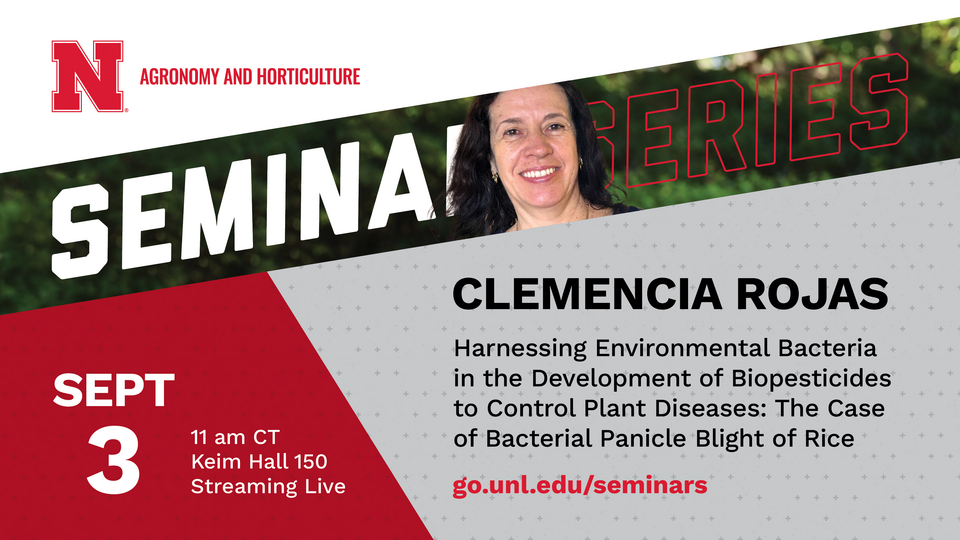
Harnessing Environmental Bacteria in the Development of Biopesticides to Control Plant Diseases: The Case of Bacterial Panicle Blight of Rice
Clemencia Rojas
Associate Professor, Department of Plant Pathology, Center for Plant Science Innovation, University of Nebraska–Lincoln
The environmental bacterium Pseudomonas protegens PBL3 produces and secretes a collection of antimicrobial molecules against plant pathogenic bacteria. Clemencia Rojas will present research on using a combination of genetic and bioanalytical approaches to identify those molecules and advance the development of effective biopesticides to control bacterial diseases of crops.
Note: This video presentation will not be posted on the website.
Sept. 10. 2026

Are Chemistry, Application Technology, and Traits Staying Ahead of Palmer Amaranth?
Jason Norsworthy
Distinguished Professor, Elms Farming Chair of Weed Science, University of Arkansas Division of Agriculture
Palmer amaranth with resistance to multiple herbicide sites of action is becoming increasingly common across U.S. cropping systems, often outpacing the commercialization of new and effective chemical options. This presentation will examine strategies for managing Palmer amaranth, along with potential future traits that could address this ongoing challenge.
Sept. 24, 2026

Soil Health and Nutrient Management: Bridging Research to Education and Extension
Bijesh Maharjan
Associate Professor, Ray and Jolene Ward Professor of Soil Health Science, Extension Specialist, Department of Agronomy and Horticulture, University of Nebraska–Lincoln, Panhandle Research, Extension and Education Center, Scottsbluff
Achieving sustainable agricultural systems requires stronger integration among scientific knowledge, industry and stakeholder engagement, and societal priorities. This presentation will provide a systems-based framework that links management decisions, soil processes, measurable indicators, and agronomic, economic, and environmental outcomes within a continuous feedback loop. Rather than treating soil health and nutrient management as a static set of metrics, Maharjan will discuss a dynamic, adaptive process shaped by human decision-making and long-term learning. Central to the presentation is the explicit inclusion of the human dimension; farmers, industry stakeholders, policymakers, and communities, recognizing that the adoption of sustainable practices depends not only on biophysical evidence but also on economic viability, risk perception, and institutional support.
Note: Maharjan was named the Ray and Jolene Ward Professor of Soil Health Science April 1 and will be honored at this special seminar. This newly established professorship in the Department of Agronomy and Horticulture honors the Wards for their longstanding contributions to Nebraska agriculture. The recognition ceremony and seminar are from 11:30 a.m. to 1:15 p.m.