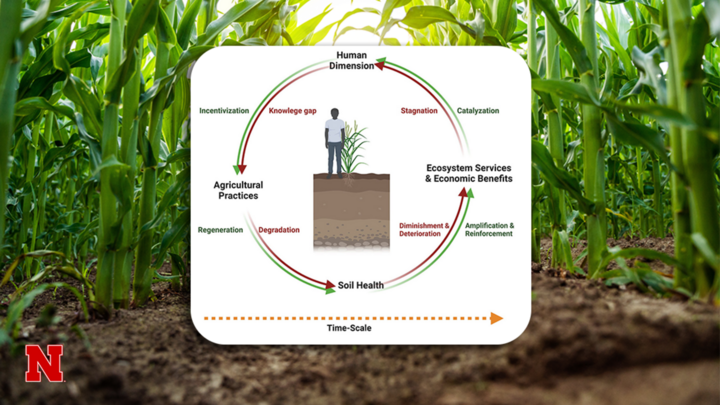
Recently published in Science Societies’ Crop Science, Soil Science, Agronomy news, "Closing the Loop: The Soil Health Cycle and the Future of Sustainable Agriculture" presents the Soil Health Cycle as a framework for understanding how soil health develops through a continuous feedback loop between management decisions, soil properties and outcomes. Rather than viewing soil health as a static condition, the SHC emphasizes it as a dynamic, long-term process shaped by both biophysical and human factors.
A central message of the article is the complex nature of health, be it soil or human, when it comes to execution, despite widespread consensus on the need for it. Improvements in soil health often occur slowly, making long-term measurements and realistic expectations critical for sustaining producer engagement and decision-making.
To move the SHC from theory into practice, the authors highlight Nebraska-based initiatives that are integrating the SHC framework. One key effort is the Nebraska Soil Health School, a collaborative extension program led by Bijesh Maharjan, associate professor in agronomy and horticulture and extension soil scientist at the University of Nebraska-Lincoln. Initially launched as a statewide educational program, the SHS evolved into an “on-demand” traveling format that brings soil health expertise directly to local communities. These events emphasize peer-to-peer learning, hands-on demonstrations, and producer-driven discussions on both agronomic and economic considerations.
The article also details the formation of the Nebraska Soil Health Coalition, an independent nonprofit organization designed to foster producer networks and community-based learning. The coalition uses a three-pronged approach that includes producer learning communities, demonstration-education clusters and stakeholder visioning groups. Its work extends beyond agronomy to explore the ROI of soil health, address social and behavioral factors influencing adoption and assimilating soil health benchmarking work with UNL and the USDA Natural Resources Conservation Service to gauge longitudinal progress.
Together, these efforts demonstrate how the SHC can be activated through education, collaboration and long-term measurement, reinforcing the idea that sustainable agriculture depends not only on science but also on strong human networks and adaptive decision-making.
The full article can be found on the Science Societies website.