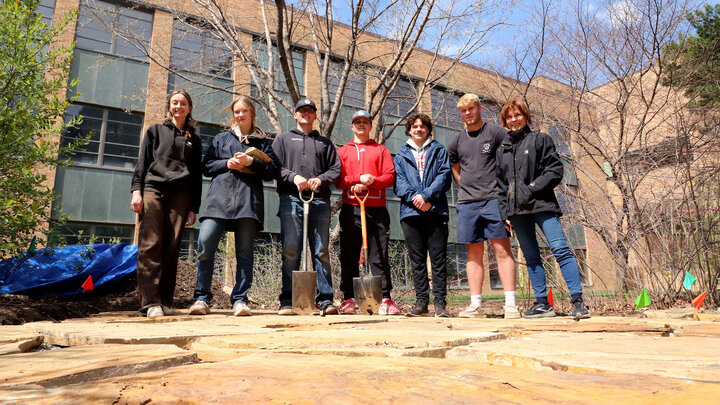
In a tucked-away corner behind Keim Hall near the Backyard Farmer garden, a group of University of Nebraska–Lincoln students in Plant and Landscape Systems 300 are learning that good design doesn’t always survive first contact with the real world.
Kneeling on the ground, shifting irregular pieces of flagstone into place, they’re doing more than building a patio — they’re testing ideas. What looked clean and certain on paper quickly became something else entirely once ground slope, existing plants and stone entered the equation.
“For me, it’s about understanding that the idea I had for this was way different than what we’re actually doing,” said Promise “PJ” Smeal, a senior in plant and landscape systems. “I’m more interested in design and management long term, but actually doing the work helps you know what’s realistic — what will work and what won’t.”

Calvin Webster (right) smooths out stone chips with the back of a rake as Alex Painter (left) and Professor Kim Todd look at the grade of the patio area.
The only physical construction course offered in the Department of Agronomy and Horticulture each spring, Introduction to Landscape Construction has students take a project from concept to completion. They must determine material quantities and specifications, plan the layout and map out the entire construction process, adapting along the way.
Instructor Kim Todd said students had to account for foot traffic patterns, drainage, shade, surrounding plants, natural entry points and even how people will feel using the space.
They have to learn to read the land,” said Todd, professor of agronomy and horticulture and licensed landscape architect. “You can’t design without understanding the environment, and you can’t build without understanding both.
Students discovered the importance of grading, material estimation and even legal considerations. What seemed like a simple project revealed some complexities, from ensuring proper drainage to blending natural stone into an existing landscape.
Max Carlson, a junior in plant and landscape systems with an interest in management, said the experience sharpened his understanding of the field’s technical side.
“There are so many rules. You have to be very specific with how you do this. This particular project might be one of the simplest — this is really all eyeballed. But, if you really want to get into this field, you need to know how to lay this out and do it, and legality is important.”
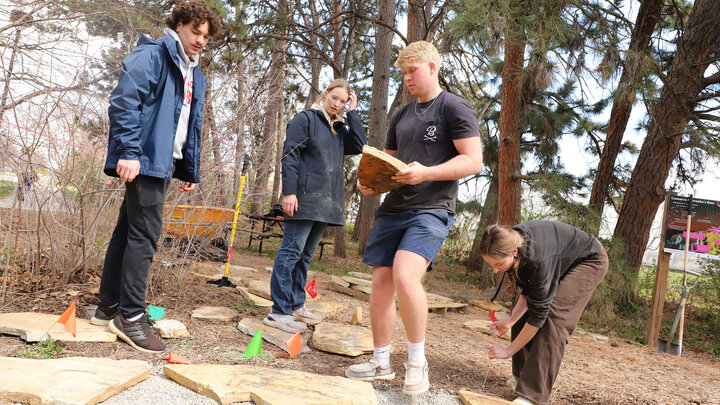
Students in Introduction to Landscape Construction work as a team, fitting flagstone pieces together like a puzzle as they build a patio.
The space will eventually include benches and subtle pathways that invite people in without overwhelming the natural setting. It’s designed to what Todd calls “human scale,” a place where people can sit, observe and feel slightly removed while still connected.
For students, though, the biggest takeaway isn’t the finished patio. It’s the process — revising plans, solving problems and learning that in landscape systems, success depends on balancing design intent with the realities of the environment.
More photos at IANR told with Exposure.


