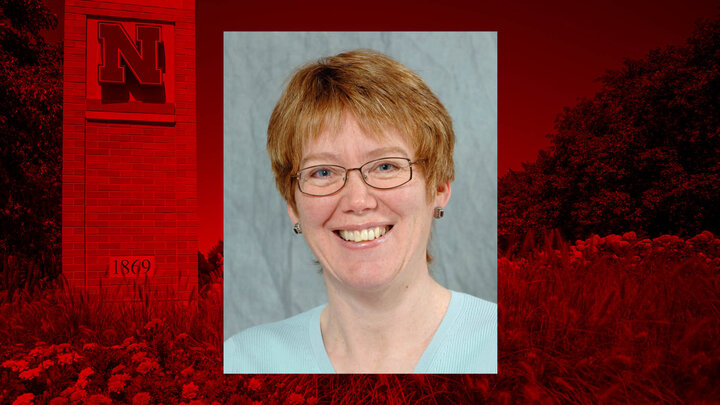
Rhae A. Drijber, professor of soil microbial ecology in the Department of Agronomy and Horticulture, retires June 30, 2026, after a 31-year career at the University of Nebraska-Lincoln.
Drijber will be recognized alongside Daren Redfearn and Jerry Volesky at a joint retirement celebration from 2 to 4 p.m. on May 8 at the Goodding Learning Center in Plant Sciences Hall. Anyone who wants to share their thoughts, stories, best wishes and photos to celebrate her retirement can sign her online guestbook.
Drijber is originally from North Vancouver, British Columbia, Canada. She earned her bachelor’s in agriculture in 1982 and her master’s in soil science in 1986, both at the University of British Columbia. During her master’s program, she realized how important microbes were in the formation of soil organic matter, so she decided to specialize in soil microbial ecology in her doctoral program.
“The soil matrix stabilized microbial products produced via decomposition of plant litter and other carbon residue inputs,” Drijber said. “Thus, for my PhD I linked the two processes using earthworms as a model and an important group of decomposer bacteria (gliding bacteria) as the conduit. Because these microbes contained a novel sulfonolipid, I was able to develop this into a biomarker to monitor their dynamics in soils. Lots of fun was had!”
She earned her doctoral degree in soil science from the University of Alberta in 1993. After graduation she took a post-doctoral research position in the same lab she worked in during her doctoral program at the University of Alberta.
Drijber began her career at Nebraska in September 1994 as an assistant professor. The faculty position at Nebraska was the perfect fit for her; a focus in soil microbial ecology with research and teaching responsibilities.
“The clincher was I knew Dr. John Doran, a well-known and respected United States Department of Agriculture soil scientist affiliated with the University of Nebraska,” Drijber said. “My husband was also up for the adventure of moving to the states.”
She has been a professor in the Department of Agronomy and Horticulture since 2008, serving in an appointment that is 75% research and 25% teaching. Drijber’s research is specifically centered on applied soil microbial ecology.
“My research focus is to identify patterns and processes of soil microbial communities important to plant productivity, soil health, soil carbon sequestration and ecosystem services,” Drijber said. “Our approach describes and quantifies the spatial and temporal dynamics of soil microbial communities as they exist in situ in natural and managed ecosystems using biochemical, enzymatic and molecular approaches.”
She attests that collaboration has been the key to her research success. Her research has resulted in about 100 peer-reviewed journal publications over the course of her career. Drijber has several research accomplishments to be proud of but she is most proud of her research that uncovered the roles of arbuscular mycorrhizal fungi (AMF), a fungal plant symbiont, in high-yield corn cropping systems.
“At the start of my career, AMF were largely studied in natural ecosystems or low fertility agronomic systems for their role in plant phosphorus and nitrogen acquisition,” Drijber said.
She and her team of researchers demonstrated the inverse relationship between nitrogen fertilization and the biomass of AMF, an important precursor to soil organic matter formation.
“We also demonstrated a key role for AMF in phosphorus uptake in high-yield corn where they spanned the phosphorus-depletion zone around corn roots thereby aiding plant phosphorus demand.”
While research has been at the forefront of Drijber’s position at the university, her role as an educator has been nothing short of exemplary. In 1999, Drijber earned a Holling Family Teaching Excellence Award, a recognition awarded to educators for “exceptional teaching in the Institute of Agriculture and Natural Resources.” That same year, North American Colleges and Teachers of Agriculture honored her with an educator award.
Drijber taught soil microbial ecology at the undergraduate and graduate levels. She said her goals as a professor were to be a good mentor for her students, be creative in the classroom and remain relevant in the industry by continuing to pursue professional development opportunities throughout her career.
“My teaching philosophy is to encourage students to be active participants in their own learning regardless of venue,” Drijber said. “In other words, I strive to inspire students to ask questions, thoughtfully reflect on those questions – and only then, seek out answers and ideas for further discussion.”
The successes of her graduate students are a piece of her legacy at Nebraska. Drijber helped her students reach their potential through active participation in their learning. She is immensely proud of her graduate students, who have gone on to work in positions within the USDA, government organizations and private businesses, and who have become university faculty members.
Ashley Stengel, one of Drijber’s former doctoral students and post-doctoral researchers, is a microbiology instructor at Oregon State University. She reflects fondly on her time learning from Drijber.
“Dr. Drijber is a rare kind of scientist who brings people together across disciplines and inspires them to see the ‘invisible world’ of microbes with fresh curiosity,” Stengel said. “Her mentorship shaped the way I think, learn and connect ideas, and I am endlessly grateful for the generosity and imagination she brings to her students. Working with Dr. Drijber taught me how to think boldly and creatively with scientific questions. She encouraged us to ‘play with the data’ until the story revealed itself. Her wit, brilliance and deep care for her students made her an extraordinary adviser whose impact continues to guide my career.”
In her retirement, Drijber has big plans to invest more time with friends, continue to show and breed Airedale Terriers, garden and travel.
“I am looking forward to spending time on our acreage with the dogs, long nature walks, creating healthy gourmet meals, catching up on books and sleep, and less time in front of a computer screen,” Drijber said.


