Using eastern redcedar-derived biochar can help farmers to produce the same amount of crop while spending less money and fewer resources. Michael Kaiser, associate professor of agronomy and horticulture, hosted a biochar field day on Sept. 22 to show farmers how they can implement biochar in their fields and explained the benefits.
“Our biggest argument is always: put biochar in the soil, produce the same amount of crop, but use less nitrogen fertilizer and water,” Kaiser said. “Make it more input efficient. If you save water, irrigation water, that saves money. If you save nitrogen fertilizer, that saves money."
In addition to savings for farmers, eastern redcedar biochar has major environmental benefits. Eastern redcedar is an invasive species in Nebraska that disrupts native grasslands, decreases forage availability and productivity of rangeland and increases the risk of wildfires — particularly near urban areas. By removing eastern redcedars and turning them into biochar, farmers can help reduce the impact of the invasive species. Using eastern redcedar biochar as a soil amendment also promotes cleaner groundwater.
“Because biochar helps to keep nitrate in the soil, then the nitrate doesn't go into the groundwater and cannot be converted to nitrous oxide,” Kaiser said. “So it's a win-win-win situation.”
As a soil amendment, biochar has to be mixed into the soil to be effective so it can react with soil particles. If placed on the surface of the soil, the biochar will be less efficient to improve water and nutrient retention and wind and water could remove the biochar altogether.
“The big aim is that we put biochar in the soil, increase the carbon which can be sold as carbon credits and that we increase the resource efficiency,” Kaiser said.
The carbon credit exchange is a way for corporations to offset their carbon emissions by purchasing virtual credits from an individual or group that is actively removing, reducing or diverting greenhouse gas emissions.
“This is a potential revenue stream for farmers who apply biochar and then can certify the carbon content in their soil that is increased and potentially get money back for it,” Kaiser said.
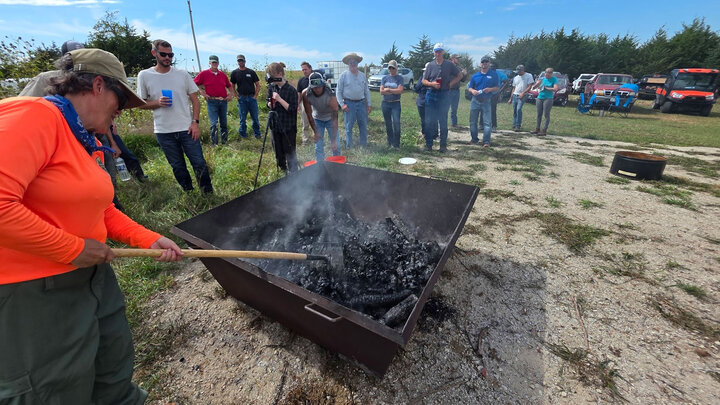
Kaiser told field day attendees all of this and more while eastern redcedar burned in an Oregon Kiln.

Samples of eastern redcedar biochar were given to field day participants.
“We had about 30 attendees from construction companies, tree service, farmers, NRCS, NPPD and someone from biochar fertilizer production,” Kaiser said. “During the burning there was a lot of time to talk about benefits of biochar, problems in production, distribution, where to apply and how to apply. There was a lot of communication among all attendees.”
Kim Slezak, a certified forester with the Nebraska Forest Service, led the biochar demonstration. She explained that the process is more complicated than digging a hole and starting a fire. Kaiser said he learned a lot from Slezak’s demonstration.
“The traditional biochar or charcoal production is done in earth mounds or in a hole in the earth, so that's possible as well, but it’s important that you have a closed system where the feedstock is and that you burn it from the top,” Kaiser said. “If you start burning from the top, it will suck out the oxygen and then you have the pyrolysis at the ground, and that will produce a biochar. We also learned that we need to have moisture content below 10%."
All participants were invited to take a biochar sample home with them and left with an understanding of how using eastern redcedar biochar as a soil amendment can benefit them and the environment.
The field day was hosted by Blue Heron Tiospaye, an indigenous nonprofit organization working on removing redcedar from their land in Seward County to restore a native prairie ecosystem.