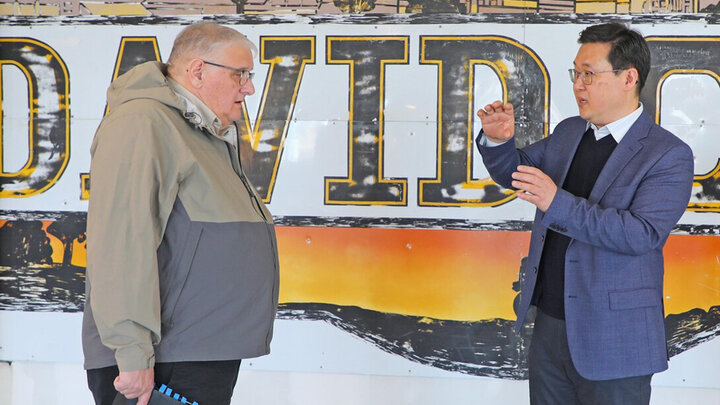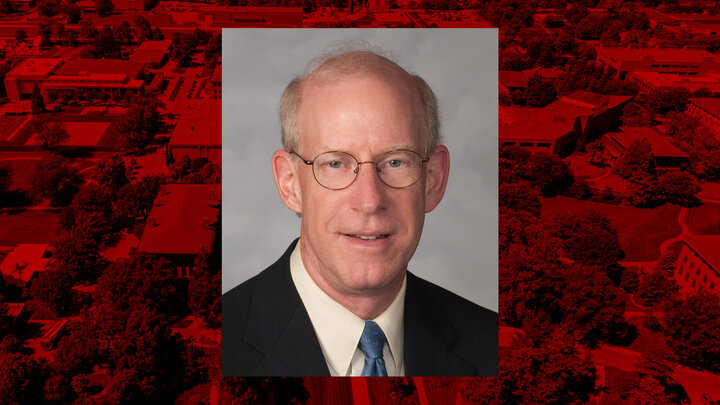
Richard Ferguson, professor of soil science in the Department of Agronomy and Horticulture, retired Feb. 28 after a 41-year career at the University of Nebraska-Lincoln.
A reception in his honor will be held from 2 to 4 p.m. March 20 in the Goodding Learning Center in Plant Sciences Hall. Cake and refreshments will be served. Colleagues may sign the online guestbook.
Richard Ferguson’s goals at the University of Nebraska–Lincoln were straightforward: help Nebraska farmers become more productive and profitable while safeguarding soil and water resources; help students understand soil variability and manage crop nutrient inputs accordingly; and support faculty and staff he supervised in reaching their fullest potential and making an impact.
But over 41 years — and through countless interactions with producers, colleagues, students, and the people of Nebraska and Rwanda — those seemingly simple goals came to define a lifetime of service and a genuine care for everyone around him.
“Richard has been an example of what it means to fully serve the land‑grant mission,” said Martha Mamo, agronomy and horticulture department head. “His leadership in nutrient management and precision agriculture has created lasting impact through research, teaching, mentoring and trusted relationships with producers and partners across the state of Nebraska.”
Ferguson did not always envision a career in agriculture. Growing up in Kansas, just one generation removed from the farm, he spent summers helping his grandfather — gaining a deep appreciation for land stewardship, even as the work worsened his severe allergies.
He did, however, love science. His parents were teachers. His father taught high school and college chemistry, and his mother taught elementary school and worked as a librarian.
After earning a bachelor’s degree in biology and chemistry from Friends University in Wichita, Kansas, in 1976, Ferguson began graduate school in microbiology at Emporia State University. After one semester, he wasn’t sure it was the right field of study, so he worked for a couple of years in the agriculture industry in Kansas, managing a grain elevator and fertilizer plant and serving as a fertilizer salesman.
During that time, he engaged with many farmers, and he soon realized they had inquiring minds — producers seeking to be good stewards of their land and to be profitable in their operations. Discussions with an industry agronomist soon helped Ferguson realize the opportunities in crop research and agricultural science.
Those encounters were influential, and he was accepted to Kansas State University to continue his education. A soil fertility scientist named Dave Kissel gave him a shot and offered him an hourly-paid student job. This forever shaped Ferguson’s trajectory in soil science.
“That opportunity allowed me to see the combination of science and agriculture into a career,” Ferguson said. “I was able to spend six years with Kissel, who was my mentor and adviser for both my master’s and PhD, and he was a tremendous example of how to lead a career in academia and soil science.”
Both his master’s and doctoral work related to nitrogen management, particularly, urea-based fertilizers and the risk of ammonia volatilization.
Ferguson’s career at the University of Nebraska-Lincoln began in 1985 at the university’s South Central Research and Extension Center near Clay Center. He was drawn to a research and extension position as an assistant professor in the Department of Agronomy because of the combination of practical research, including field and lab studies, and the ability to share what he learned directly with farmers.
“One strength Nebraska had at the time was the system of research and extension centers,” Ferguson said. “There were five — I think that was the strongest combination of research and extension capacity that existed in the country.”
Charles Stonecipher, the director of the South Central Research and Extension Center at the time, wanted Ferguson to focus on getting to know the people and the region rather than research. So, his first field studies didn’t start until a year later.
Having a joint appointment is one aspect that Ferguson has valued the most in his career.
“It has been important to learn from farmers, the issues they’re dealing with, and do research to address those issues,” Ferguson said. “Being able to take the research I've learned from and give it directly to farmers, and then eventually being able to use all of those examples in the classroom, is key.”
When Ferguson started at Nebraska, about 75% of the irrigated land was furrow-irrigated.
“Today it's probably more like 80% center pivot systems,” he said. So it was very challenging to manage nitrogen in a farm system, especially if the first irrigation applied 8 or 10 inches of water. If your nitrogen fertilizer was in place, it could be lost right away.”
Over time, Ferguson and his colleagues learned the importance of managing irrigation and nitrogen more efficiently. He worked on the application of fertilizer to maintain its availability to the crop and prevent its loss to the environment.
The early precision and site-specific nitrogen management Ferguson was involved in began with the soil, understanding soil variation and measuring it through soil sampling.
“With nutrient use efficiency, there were opportunities for larger-scale funding research projects, but not at the scale that one would see today, which didn’t exist back then,” he said.
He did have funding from the Nebraska Natural Resources Districts. His first large-scale project was the Mid-Nebraska Water Quality Demonstration Project, a water-quality demonstration funded by the U.S. Department of Agriculture as part of the National Water Quality Initiative.
Ferguson was promoted to professor and granted tenure in 1999.
“Richard has been one of my best friends and a solid colleague since the day he interviewed for his position at South Central Research and Extension Center back in the early 80s,” Roger Elmore, professor emeritus in agronomy and horticulture, said. “His character traits include being wise, thoughtful, patient and kind. He is a top-notch, innovative soil scientist excelling in teaching, research, extension and administration.”
When the South Central Research and Extension Center closed in 2003 due to budget cuts, he moved to Lincoln with the same focus. However, this career change also involved teaching and, eventually, administration duties.
Ferguson’s goal remained the same — to help Nebraska farmers become more productive and profitable while protecting their soil and water resources.
He received national recognition for Project SENSE, a collaborative on-farm research and educational effort exploring the impacts of in-season, sensor-informed nitrogen management on crop yield, nitrogen use efficiency and profitability.
Over three years, 54 on-farm study sites across Nebraska compared growers’ standard nitrogen management to sensor-based, in-season approaches. Sensor-based management reduced nitrogen application by 29 pounds per acre and significantly improved nitrogen use efficiency, producing more grain per unit of fertilizer. Yields were slightly lower but net returns were higher. While benefits varied by site, ongoing research was refining those approaches and expanding the use of tools such as drones, aircraft and satellite sensors to improve in-season nitrogen management.
“I think we have developed processes and nitrogen management in Nebraska that eventually will become the model for the nation and maybe globally,” Ferguson said. “So, detecting the need for nitrogen in crops and applying that in timely ways, that limits the environmental impact of crop production — those are two things that I think I've been very fortunate to be able to contribute to in my career.”
Ferguson began serving in administrative roles for the Department of Agronomy and Horticulture as associate head for five years, starting in 2012, and later as interim department head in 2017 for 18 months.
“As a large and extremely diverse department, we had a lot of resources and a lot of responsibilities,” he said. “I really enjoyed getting to know the breadth of work our faculty were doing across the state and getting to know their work better, and how that ties to the depth of work here in Lincoln.”
During his years in administration, he saw significant growth in agricultural technology and in the number of faculty in plant breeding, genetics and biotechnology.
“While a three-way or four-way appointment can be challenging, I really enjoyed the opportunity to intertwine research, teaching and extension in ways that I hope were impactful,” Ferguson said.
Teaching for Ferguson included farmers, crop consultants, fertilizer dealers, NRD staff, and other practitioners, as well as students in formal classes. His extension courses covered nitrogen management, precision agriculture and soil management. He taught Agronomy 431 Site-Specific Crop Management and Agronomy 831 Spatial Variability of Soils. He also advised a total of 13 master’s and doctoral students over his career.
His appointment combination also set the stage for Ferguson to work outside of Nebraska for five years as the inaugural vice chancellor of the Rwanda Institute for Conservation Agriculture, helping establish a new, land-grant modeled agricultural university for East Africa.
In 2018, after serving 34 years at Nebraska, he stepped into this new role to help develop RICA, an English-language institution dedicated to educating and inspiring a new generation of agricultural innovators in Rwanda. Among his many accomplishments, Ferguson is especially proud of seeing the institution’s first class of students graduate in 2023.
Ferguson has published over 100 research articles, 22 book chapters, research bulletins or refereed proceedings, and over 90 extension bulletins and newsletters. He has been recognized as a Fellow of the American Society of Agronomy, the Soil Science Society of America and the Daugherty Water for Food Institute, and is a recipient of the American Society of Agronomy Werner L. Nelson Award for Diagnosis of Yield Limiting Factors, the Leo Walsh Lectureship of the Soil Science Society of America, the Fertilizer Industry Award for Innovative Technologies Advancing the Fertilizer Industry, the Water Guardian Award from the Mid-America CropLife Association and the Epsilon Sigma Phi Award of Merit, among others.
“The strong foundation Richard built will continue to guide the Department of Agronomy and Horticulture as we move into the next era of digital agriculture research, teaching and extension,” Mamo said. “I am honored to be his colleague and have benefited immensely from his mentorship.”
In retirement, Ferguson plans to remain engaged with the agronomy and horticulture department to help as appropriate, and spend more time developing his photography hobby, refining his gardening skills, traveling with his wife to see his family and spending more time as a grandparent.