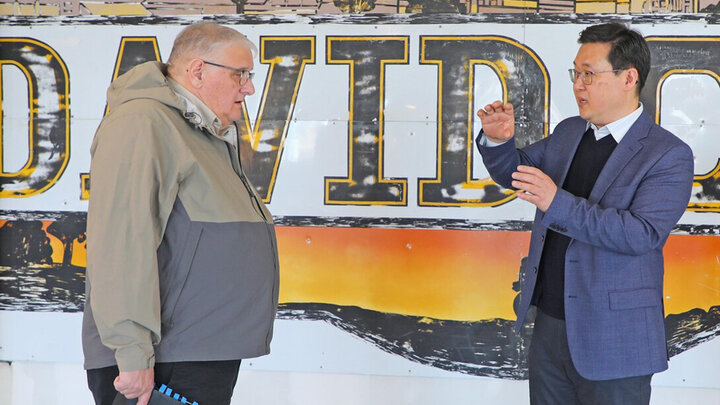
Cheryl Dunn, president of the Society for Range Management, organized a conference last fall that brought students, educators and professionals in rangeland management together to share their research and learn from one another.
The University of Nebraska-Lincoln hosted the Society for Range Management and Natural Legacy Project Joint Conference on East Campus Oct. 7-9.
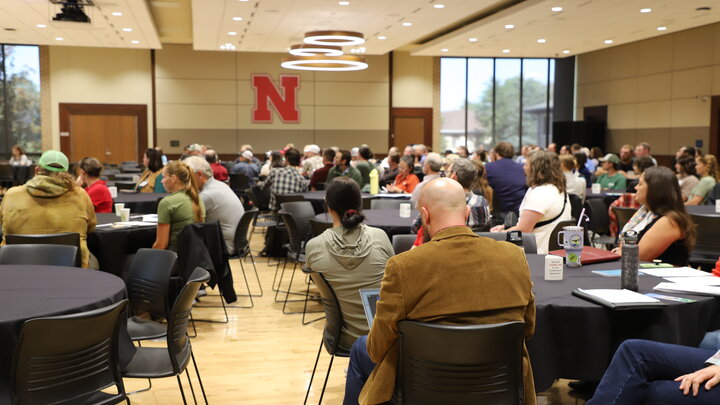
With over 200 attendees and 50 groups represented, Dunn said the conference was a success. Undergraduate and graduate students, high school students, university faculty and staff, representatives from Nebraska Game and Parks, nonprofits and Nebraska Natural Resources Districts gathered together in Nebraska’s capital city to listen to speakers, watch demonstrations and discuss the management of grasslands and rangelands.
The conference was also an opportunity to highlight the successes of Nebraskan stakeholders in natural resource management. Lillie Hoffart, a Nebraska student, won the Best Student Presentation Award and Gerry Steinauer of Nebraska Game and Parks Commission won the Natural Legacy Conservation Award. Joel Bramhall, director of federal programs and curator of the Crete Public Schools Arboretum, won the Natural Legacy Education Award and Les and Jan Graham won the Nebraska Society for Range Management’s Rangeman’s Award.
Dunn used a $1,000 grant from the Center for Transformative Teaching to pay for 20 of her students to attend all conference events and network with speakers and participants.
“I think the one sad thing was probably the federal shutdown,” Dunn said. “We didn't get to have that federal presence that we're used to having. I think that was unfortunate.”
Speakers covered an array of topics, spanning from expected lectures on prescribed burns, land management, increasing grassland awareness and creating habitat for pollinators, to unexpected presentations about using beetles to assess ecosystem function, leveraging big data for grassland bird conservation, evaluating bat acoustics and eco-tourism.
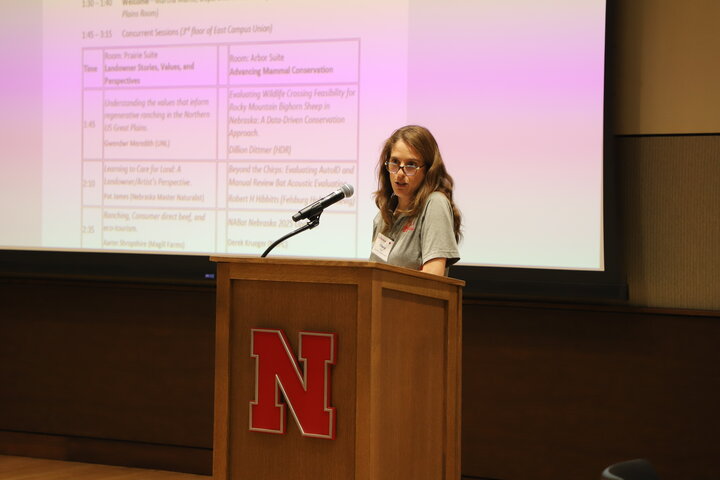
“Somebody came up to me and they said they love the fact that you can go to a grazing talk and then go and learn about bees or butterflies or something else, because it’s all connected,” Dunn said.
Walt Schacht, professor emeritus of agronomy and horticulture, was the keynote speaker. He spoke about Nebraska’s natural legacy and how it relates to range management.
In addition to speakers, participants had the opportunity to learn through hands-on demonstrations. Participants could take a mock plant identification or range management exam to test their knowledge, peruse trifolds covering topics like Nebraska’s invasive plants and the grazing quality of various wildflowers or take a field trip to the Little Salt Fork Marsh to experience eastern Nebraska conservation efforts firsthand.
Dunn’s grassland education trunks, containing lesson plans and activities designed to help teachers and their students understand why grasslands are valuable, were also on display.
Dunn emphasized that the conversations between landowners, educators, researchers, conservationists and the rising generation were integral to the conference’s success. Ann Dvorak, program specialist at the World Wildlife Fund’s Sustainable Ranching Initiative, and Laura Nelson, statewide grasslands coordinator at the Nebraska Grazing Lands Coalition, led a roundtable discussion where every single participant at the conference gathered for a discussion about how they, as stakeholders in range management, communicate and how they can do it better.
The Nebraska Society for Range Management also hosted a youth forum, providing an opportunity for a similar discussion among Nebraska’s youth.
“I think we're building off of something here where these groups work really well together,” Dunn said. “They're not competing interests. They overlap so nicely with one another. And to have them all in one space just allows for so much more creativity with projects and protecting Nebraska and Nebraska's wild lands. That's amazing.”