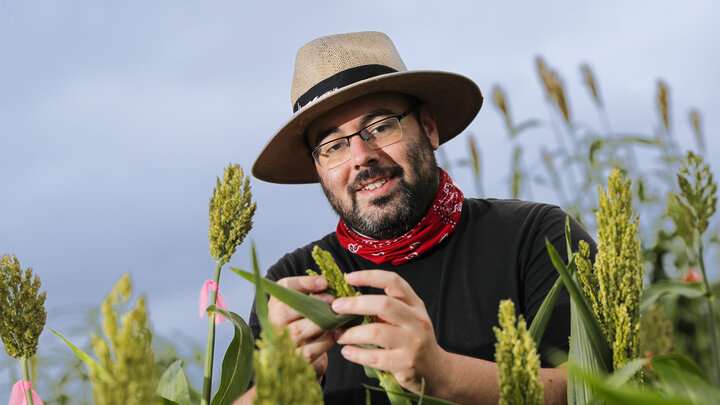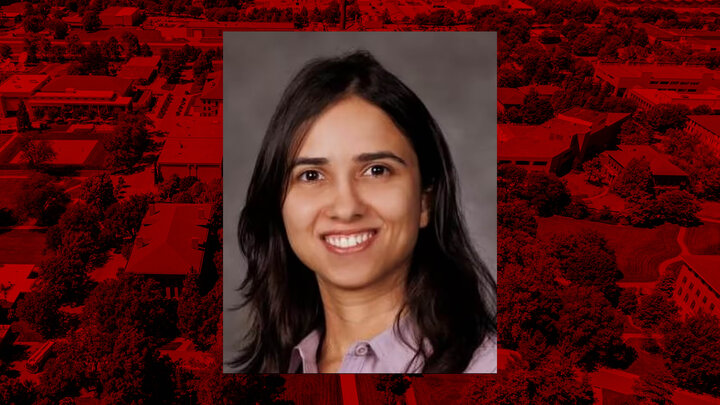
A childhood spent on her grandparents’ farm in Nepal sparked Ritika Lamichhane’s fascination with agriculture. Her passion for education came from her parents. As an extension educator for the University of Nebraska-Lincoln, Lamichhane is a perfect combination of her family’s influence, using her expertise in precision agriculture and relationships with farmers to answer their critical questions and find solutions to their agronomic problems.
“We grew a lot of rice back home, so my grandparents – my grandfather, and my grandmom – they used to farm,” Lamichhane said. “And then my dad decided that he didn't want to farm, so both my parents are teachers, actually. And I guess I'm a combination of both.”
Agriculture is a huge part of Nepal’s economy, but the majority of farms are subsistence farms. Lamichhane, however, was more interested in the precision agriculture equipment and drones used in larger-scale agriculture.
“In the United States, we have big farms, big machines,” Lamichhane said. “But back home, the land is very fragmented. We have small, self-reliant farms.”
Lamichhane is a water and cropping systems extension educator specializing in precision agriculture and nutrient management. She earned her bachelor’s in agriculture from Agriculture and Forestry University in Bharatpur, Nepal in 2018 and her plant sciences master’s in 2023 from the University of Idaho. One week after graduation, Lamichhane began working for Nebraska Extension. In October, she accepted an affiliate designation with the Department of Agronomy and Horticulture.
In her role as an extension educator, Lamichhane serves Johnson, Nemaha, Pawnee and Richardson counties. Answering phone calls from farmers who have questions about precision agriculture and nutrient management is a huge part of Lamichhane’s role, but she also leverages her master’s program expertise in wheat to support Nebraska’s wheat growers. She also helps farmers conduct on-farm research, which presents opportunities for department collaboration.
Currently she is working on a wheat sensor-based nitrogen management project with agronomy and horticulture research assistant professor Guillermo Balboa and a wheat sulfur application project with agronomy and horticulture associate professor Javed Iqbal. She is also collaborating with professors in the plant pathology and entomology departments on a soybean insect pest management project.
“I believe that with the affiliate program, it will kind of expand these opportunities and then I will get more opportunities to collaborate with these faculty members – then maybe we can do a lot of joint projects,” Lamichhane said. “And we can get some funding to do this research, which will definitely increase the reach and impact of my work.”
In addition to her extension roles, Lamichhane is the lead educator in the Nemaha County office, she also works closely with county commissioners and local communities communicate the needs she identifies.
Next year, Lamichhane plans to speak in local middle and high school agriculture classes to help youth understand the breadth of career opportunities in agriculture. Lamichhane says she encounters farmers who are uncertain about the future of their farms and their legacies because their children are not interested in farming. She hopes her programming will help the next generation explore the vast opportunities agriculture has to offer.
“Agronomy is just one part of agriculture – there are different aspects of agriculture,” Lamichhane said. “In precision agriculture and technology, you can work on your computer or you can work with some software, and that is also a viable career in agriculture. I would like to inspire the next generation to explore this ag technology and different careers in agriculture.”
Lamichhane loves that each day of her job is different and that her work pushes her to consistently solve problems.
“The whole process of working together with different entities and trying to find a solution, that process is really exciting for me,” Lamichhane said.
Sometimes finding a solution means adapting to changes in weather or unexpected roadblocks, which can be frustrating, but Lamichhane remains optimistic in the face of adversity because she knows that every step towards a solution is a step in the right direction.
“Even if we didn't find the exact answer to this, we are on the way – we will get there,” Lamichhane said.
Having spent time around farmers in Nepal, Idaho and Nebraska, Lamichhane said she sees many similarities between the farmers in the United States and in her home country.
“At heart, people are the same,” Lamichhane said.
But Lamichhane says Nebraska stands apart in its people’s "Nebraska Nice" mentality and farmers’ appreciation for the university and Nebraska Extension.
“One thing that I've noticed with the people here in Nebraska, they're just very sweet people,” Lamichhane said. “I'm not from here, but I have always felt that they have welcomed me with open arms and they're always eager to learn from me. Also, the love that they have for the university and extension, you can see that. The relationship that the educators before me built with these farmers and the relationship that extension has with farmers, I can feel that.”