Two University of Nebraska–Lincoln scientists, partnering with American Farmland Trust, extension educators and four Nebraska farmers, have established a biochar on-farm research network which is among the first and largest in the United States.
According to ongoing research at Nebraska, applying biochar to agricultural soil is a promising approach to building healthy soils and promoting long-term, input-efficient agroecosystems. Biochar is produced by pyrolyzing or combusting organic waste biomass at high temperatures under low-oxygen conditions.
Guillermo Balboa and Michael Kaiser, researchers in agronomy and horticulture, report that field observations indicate significant, long-lasting positive effects of biochar on soil carbon and water storage, but the impact of biochar on soil nitrogen retention to improve nutrient-use efficiency in row-crop systems is less clear. Scalable field data from different soils under varying water and nitrogen management strategies are missing and critically needed to guide farmers.
Balboa says this is where research data from the Nebraska on-farm research network will be critical for generating new insights.
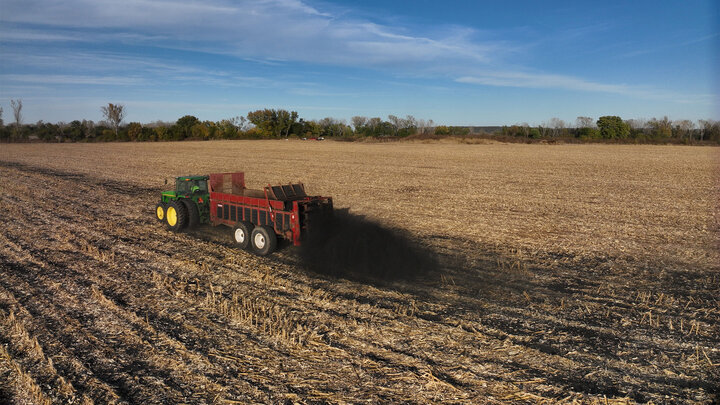
Video of biochar application at Nebraska research sites in the Fall of 2025.
Video credit: Facundo Gilardoni and Madalyn Backes | Agronomy and Horticulture
This on-farm research network is part of the AFT-led Conservation Innovation Grant, “Breaking Down Barriers to Biochar Adoption on Farms from Coast to Coast.” It is funded through the U.S. Department of Agriculture’s Natural Resources Conservation Service and led by Bianca Moebius-Clune, AFT national director of climate and soil health and the project’s principal investigator.
“We are glad to partner with the University of Nebraska and leverage their great expertise in biochar research as part of AFT’s national demonstration trials network that includes an additional 30 sites and is growing across the U.S.,” Moebius-Clune said.
Through the leadership of Steve Melvin and TJ Prochaska, cropping systems extension educators, four Nebraska farmers engaged in on-farm evaluation of biochar.
The Nebraska research sites are near Silver Creek, Plattsmouth, Aurora and Central City. Each site covers 5 acres, with biochar applied to about 2.5 acres at an average rate of 8 tons per acre using a replicated design. Each site is in a corn-soybean rotation, and three nitrogen management strategies will be tested, including timing and rate.
“The research network will provide information for the farming community on which site conditions and nitrogen management will provide the largest biochar benefits for more efficient use of this critical resource,” Balboa said. “Biochar may help lower the amount of nitrogen fertilizer needed without compromising on the yield.”
Kaiser added that the project will also deliver valuable experiences for the large-scale application and usage of biochar in agricultural landscapes.