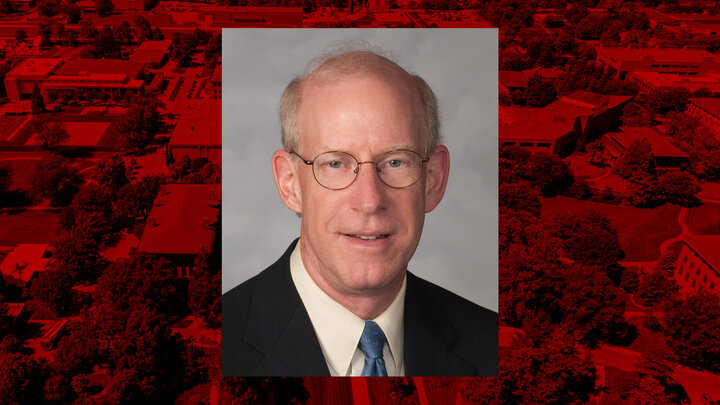
Thomas S. Payne, Calvin O. Qualset, and the late James “Jim” Specht, University of Nebraska–Lincoln alumni, received the Department of Agronomy and Horticulture 2025 Alumni Lifetime Achievement Award. They will be honored at the department’s Spring Banquet at the Nebraska East Union on Friday, April 15, 2026.
This award is the highest honor bestowed upon graduates of the department who have made significant contributions to their community, state and nation through professional service, public service and/or civic engagement.
Qualset is an internationally respected geneticist and plant breeder whose work has strengthened cereal crop productivity and sustainability. Over decades at the University of California, Davis, he contributed to the development and release of more than 24 improved wheat, barley, oat and triticale varieties, helping to transform California agriculture and improve food systems worldwide. During his tenure, wheat yields in California doubled and acreage expanded threefold, reflecting the combined impact of improved genetics and sound agronomic practices. Beyond cereal grain variety development, he played a foundational role in shaping national and international efforts to conserve crop genetic diversity. He was the founding director of the UC Genetic Resources Conservation Program.
Qualset was raised on a farm near Newman Grove, Nebraska. He earned a bachelor’s degree in technical agriculture from the University of Nebraska in 1958. He went on to UC, Davis, where he earned his master’s degree in agronomy in 1960 and a doctoral degree in genetics in 1964. In 1966 he completed advanced training in quantitative genetics at Brown University through a Summer Institute sponsored by the National Science Foundation.
He began his academic career as an assistant professor at the University of Tennessee, Knoxville, in 1964 before joining the faculty at UC Davis, in 1967. He progressed through the academic ranks to professor in 1973 and continued his association with UC Davis as an emeritus research professor following his formal retirement in 1994.
Payne has devoted his life on strengthening the genetic foundation of one of the world’s most important food crops and helped shape global wheat improvement and conservation. He spent his entire professional career with the International Maize and Wheat Improvement Center, the world-renowned nonprofit agricultural research center founded by Nobel Peace Prize laureate Norman Borlaug.
CIMMYT operates under the global agricultural research partnership known as the Consultative Group on International Agricultural Research, with a mandate to improve food security in developing and food-insecure nations.
Payne served as head of CIMMYT’s Wellhausen-Anderson Wheat Genetic Resources Collection, the largest and most heavily utilized wheat germplasm bank in the world, until his retirement. In addition to leading the germplasm bank, he directed the CIMMYT International Wheat Improvement Network, a global partnership of hundreds of scientists testing around 1,000 new wheat lines annually across more than 700 sites in over 90 countries. Beyond research, he became one of CIMMYT’s most trusted institutional leaders. He served as assistant director and interim director of the Wheat Program and as secretary of the CIMMYT Board of Trustees during periods of significant restructuring within CGIAR.
Payne was born in Lincoln, Nebraska. He attended the University of Nebraska–Lincoln and earned his bachelor’s degree in crop production in 1981. He completed a master’s degree in plant breeding from the University of Minnesota and a doctorate in plant breeding and genetics in 1988 from Nebraska.
Specht was a nationally recognized authority in soybean genetics, physiology and crop production whose work helped define modern soybean productivity. Over a 50-year career, he advanced both the scientific understanding and on-farm performance of soybeans, improving yields, water use efficiency and profitability for growers across the United States and beyond.
Internationally recognized for his leadership in applying modern genomic tools to soybean improvement, Specht contributed to a national research team that developed the first molecular marker–based genetic map of soybean, organized into 20 linkage groups. This work helped position soybean among the first major crops with a fully mapped genome. Published in Nature in 2010, the soybean genome sequence paper marked a turning point in soybean genomics and laid the groundwork for advances in genetic marker technologies, including high-resolution mapping and the eventual assembly of the complete soybean genome.
Specht is widely recognized for his research on the genetic basis of soybean yield response to water availability. He also showed that the standard water use efficiency was negatively associated with yield under drought stress. By mapping genomic regions associated with yield response to water, his work established that these responses are genetically controlled traits, enabling the identification and manipulation of genes to enhance water productivity across diverse environments and production systems.
Beyond the laboratory, Specht translated science into practice. He was a strong advocate for earlier soybean planting to maximize yield potential and, through research-based recommendations, helped shift average planting dates in Nebraska and across the Midwest from mid-May to mid-April.
Specht was raised near Scottsbluff, Nebraska, on a farm that produced irrigated sugar beets and other crops. He attended Nebraska and received his Bachelor of Science degree in agronomy in 1967. Specht then attended the University of Illinois, Urbana-Champaign, in pursuit of a master’s degree in maize genetics and breeding. This was interrupted by United States Army military service during the Vietnam War. After completing his service, he returned to Illinois to finish his degree in 1971. He completed a doctoral degree in 1974 at Nebraska focusing on soybean genetics and physiology.
In 1975 he began his career at Nebraska as an assistant professor in the Department of Agronomy and Horticulture. As a soybean physiologist and geneticist, he studied soybean yield response to drought and water irrigation providing expertise to Nebraska growers on optimized irrigated production practices.
Specht advanced through the academic ranks to be named the Charles E. Bessey Professor and Professor of Agronomy and Horticulture. In 2010, he became the first recipient of the Francis & Dorothy Haskins and Charles E. Bessey Professorship in Plant Genetics, an endowed position established to recognize excellence in plant genetics research.
Full biographies of award recipients are available at https://go.unl.edu/2025-lifetime-awards.
This award was founded in 2016 to recognize alumni who have enhanced the reputation of the department and the university by distinguishing themselves in their careers. Honorees are selected by the Agronomy and Horticulture Alumni Advisory Council.