The University of Nebraska-Lincoln’s Center for Great Plains Studies has spent five decades advocating and elevating the Great Plains as a unique and worthwhile landscape for research, appreciation and conservation. In 2026, the center is looking back on its roots and reflecting on its future.
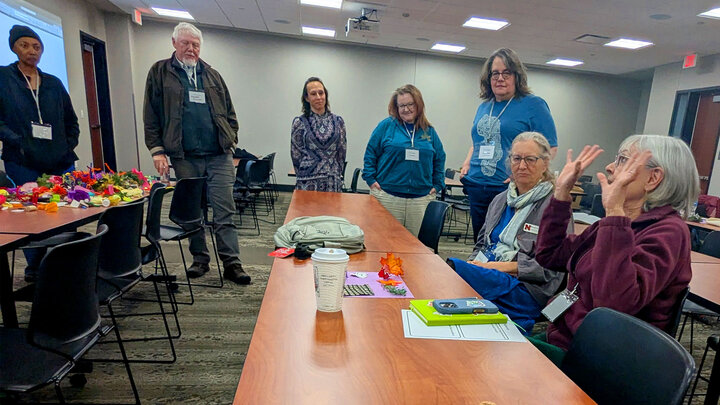
In February, Great Plains Fellows Jaime Lopez, assistant professor of community and regional planning, and Brooke McWherter, a natural resource social scientist in agronomy and horticulture, brought participants together during a Center for Great Plains Studies futuring event to reflect on these themes through a play-based community engagement workshop. Created by urban planner, community activist and artist James Rojas and urban and landscape designer John Kamp, the “Place It!” approach blends hands-on model building with guided dialogue. It invites participants to reflect on meaningful memories, uncover shared themes and values, and translate those insights into conversations about collective hopes for the future.
Workshop participants were asked to select from an assortment of materials — pipe cleaners, toy figures, artificial flowers and popsicle sticks — to build models representing their favorite memories of the Great Plains. They then shared these creations with the larger group, explaining why the memories mattered and what they might reveal about the kind of future they hope to see for the region.

One participant created a model about visiting Pioneer Park and said, “My favorite memory was going to Pioneers Park with my family to see the Buffalo, and by that, I started my love of nature and horses, as along the ride to the park was a pony ride. So, we always stopped to ride the ponies in a circle, and they endeared them into my heart and my life. Even today, I have horses and live on an acreage.”
Reflecting on their past
Workshop participants shared memories that touched on childhood play, family trips and adventures with their own children. Participants first shared their memories and experiences with one another, highlighting the diverse spaces across the Great Plains — from the Flint Hills of Kansas to many parts of Nebraska, including Scottsbluff, York and Cedar Point Biological Station. Memories also included gardens, living in local neighborhoods and near the airbase, and more urban settings such as the Lincoln Public Theatre, Pinewood Bowl Theatre, Community Playhouse, and Nebraska Innovation Campus.
The group shared a variety of themes that included a fondness for nature such as Bison and horses, watching burrowing owls, bees and the stars, in some cases, early experiences that led to a lifetime appreciation for particular elements of nature.
One participant shared a memorable experience with wildlife, “Seeing a burrowing owl at Cedar Point Biological Station for the first time on a fence post and prairie dogs. I had not seen either of these animals in the wild before.”
Participants also engaged their senses to talk about the sounds of insects, smells and colors of flowers and the physical activities they remembered, including basketball, gardening and playing outdoors.
Another participant shared their memory about looking out on the Flint Hills. “I was getting ready to graduate from grad school and reflecting on the possibilities for what was next, and feeling excited by the idea of Kansas wanting me to stay. The smell of the prairie bloom, the spring sun, the breeze, red buds blooming, the lines of fire, the black char, the neon green of new growth — it was so place-specific and exciting, a sense of newness and a sense of belonging all rolled up in one moment.”
“Overall, participants realized that despite their varied memories, they still shared values of community and connection and not just connection with each other but with nature, community and family,” McWherter said.
Looking to the future
McWherter and Lopez asked participants to describe what a thriving Great Plains could look like to them. In response, they drew on their identified shared values to paint a picture of the future.
A thriving landscape is one in which people, reconnected with the land and communities, are built on trust and security, places where children can be outdoors, play freely and develop a sense of independence and wonder. Also, a region defined by vibrant towns and communities, where people are meaningfully employed and experience their own sense of well-being.
“This workshop showed that meaningful conversations about the future can start with something simple: remembering,” McWherter said. “By creating space for people to reflect, share and listen, we can begin to build a more shared understanding of what people love about the Great Plains, what it could look like and how all might get there together.


