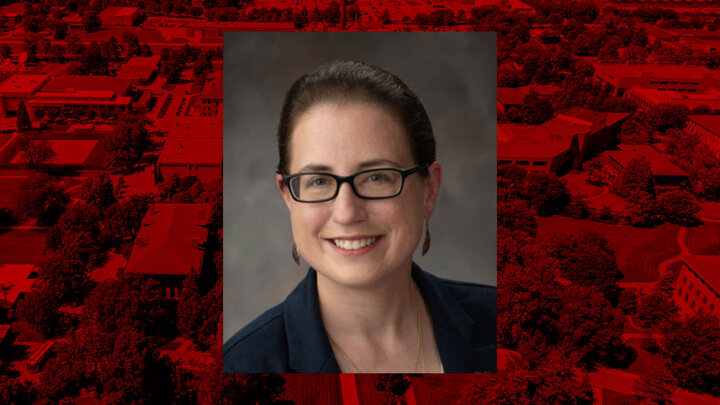
On Sept. 1, 2025, Brandi Sigmon began her new position as an associate professor in the Department of Agronomy and Horticulture at the University of Nebraska-Lincoln.
Sigmon grew up in Hickory, North Carolina, where her interest in plants and science developed.
“My mom would let me plant whatever I wanted to in her flower beds, including different flowers and vegetables,” Sigmon said.
Her early interest in plants led her to become a first generation college student and study biology. She earned her bachelor’s in biology from Mars Hill College in 2003 and a year later she started a doctoral program in genetics at Iowa State University. She graduated in 2010.
“I decided to become a professor when I was an undergraduate teaching assistant for genetics and cell biology,” Sigmon said. “That's when I knew I loved teaching science and wanted to pursue a Ph.D. in Genetics.”
Sigmon first came to Nebraska in the fall of 2015. Her husband, Benny Mote, applied for a position as an assistant professor and swine extension specialist in the Department of Animal Science at the university. She began doing a combination of research, teaching and academic advising at the university as well, working as an associate professor of practice in the Department of Plant Pathology and as an academic success coordinator for the microbiology program.
A key and rewarding part of her job was working with students in the microbiology program as the academic success coordinator. Her efforts had a positive impact on students’ academic progress, but more importantly, it helped students in the microbiology program see themselves as microbiologists and scientists.
“During this time, I developed new courses, connected students with experiential learning opportunities and developed STEM professional development workshops as part of the Microbiology Achievement through Research and Valuable Experiential Learning or MARVEL program,” Sigmon said.
In her new position, Sigmon was “thrown” into teaching PLAS 215, an undergraduate genetics course. She will teach genetics again in the fall and next spring, “trying to fill Dr. Don Lee’s big shoes.” Lee retired last October. Sigmon’s new position also has a research focus.
“I'm still wrapping up some research projects from my previous position that focused on the effects of nitrogen stress on inflorescence traits in sorghum,” Sigmon said. “Going into my new position, my research will focus more on the effects of implementing undergraduate research experiences in the classroom on student learning and success.”
Sigmon has always wanted to teach genetics and is very excited to finally have the chance to do exactly that.
“I'm looking forward to being part of a team of wonderful breeding and genetics faculty and helping to grow the genetics footprint here in the department,” Sigmon said. “All the faculty, students and staff have been wonderful! This is a great department and I'm excited to be here.”
She says her greatest professional accomplishment was receiving the Holling Family Teaching Excellence Award: Early Achievement Faculty from the College of Agricultural Sciences and Natural Resources in 2022, in recognition of her dedication to teaching and her students’ success.
“I care a lot about teaching and helping to prepare students for their futures,” Sigmon said.
Outside of work, Sigmon loves doing just about anything outside. She loves hiking and is an avid gardener.


