
For some students in the University of Nebraska–Lincoln’s plant and landscape systems major, learning begins on the practice fields maintained by Nebraska Athletics, where students apply classroom concepts to the daily demands of collegiate sports turf management.
Most of the turfgrass students working with Nebraska Athletics began in their first semester on campus. Alex Painter, Easton Petsche, Jaden Krenzer, Riley Dinslage and Carson Vachal graduate in May with degrees in plant and landscape systems with an option in turfgrass science and management. Aaron Barnhouse and Ryan Knipping are scheduled to graduate in December and May 2027, respectively.
For these students, the experience has provided far more than a campus job. It has become an extension of the classroom and, in many cases, a pathway into the turfgrass industry.
“Working at Nebraska Athletics has provided our students with valuable opportunities to expand their knowledge of the turf industry,” Anne Streich said. “Prior to this experience, many had only worked in the golf industry.”
Streich, a professor of practice in agronomy and horticulture, teaches the Introductory Turfgrass Management course, coaches the turfgrass competition team, supervises internship experiences and serves as academic adviser to all turfgrass science and management students.
Students working for Nebraska Athletics are involved in nearly every aspect of field maintenance, and they are overseen by Alex Harter and David Berger. Their responsibilities include mowing, painting, aeration, overseeding, irrigation management, topdressing and fertilizer and pesticide applications across facilities such as the soccer field, football practice fields and the track and field venue.
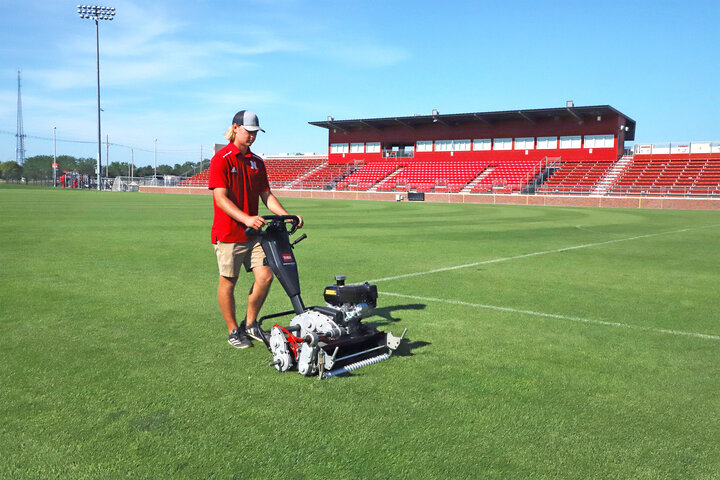
Easton Petsche mows the turfgrass at the Barbara Hibner Soccer Stadium field.
Fran tenBensel Benne | Agronomy and Horticulture
“Working with a successful sports program provides valuable experience in collegiate athletics,” Barnhouse said. “It also opens the door to hands-on internships — whether on golf courses or managing sports fields — where we can apply what we learn in the classroom.”
Krenzer said working at a sports turf facility, rather than a golf course, allows him to develop a different set of turf management skills focused on a smaller area.
Vachal said the opportunity allowed him to broaden his experience beyond baseball fields.
“I just wanted to see the other side of sports turf,” Vachal said. “I’ve done a lot of baseball, so I wanted to see if maybe I’d like soccer and football a lot more. I wanted to gain more knowledge about sports turf.”
The work also exposed students to large-scale athletic field projects, including Nebraska Athletics’ transition from cool-season grasses to warm-season bermudagrass on one of the practice football fields.
“Alex and David have both been excellent mentors, sharing their knowledge and providing opportunities for the students to gain hands-on experiences managing high-quality sports turf fields,” Streich said.
Through this process, students observed and experienced the different management strategies required for maintaining an aggressive warm-season grass compared with the cool-season grasses more commonly used in Nebraska.
“One of the biggest differences is the maintenance and protocols that we do with warm-season grass,” Harter said. “You’re a little more aggressive with bermudagrass. We topdress and verticut more often and mow it at a different height.”
Because bermudagrass thrives in warmer weather and spreads through rhizomes and stolons, it recovers more quickly from athletic traffic and requires different moisture management strategies than Kentucky bluegrass surfaces. Harter said learning to manage multiple turf systems gives students a competitive advantage entering the workforce.

Riley Dinslage measures surface hardness on the Nebraska football practice field using a Clegg impact hammer, a tool used to help ensure player safety. The target range typically falls between 70 and 80, with 100 considered the upper limit. Turf staff test 10 to 15 locations across the field, record the readings and adjust areas that fall outside the desired range. If a section is too firm, they may aerify or topdress the field to soften it or loosen the soil and sand. If the surface is too soft, they can roll the area to increase firmness and improve consistency.
Fran tenBensel Benne | Agronomy and Horticulture
Ryan Knipping, a junior in the program, said the experience revealed the level of precision required to maintain elite athletic facilities.
“My biggest takeaway from working with the athletics department is just how much work it takes to maintain a high-level practice field,” Knipping said.
For many students, the hands-on nature of the work is what makes the experience especially valuable.
“I learn best by doing, so I’ve gained a lot through hands-on work,” Painter said. “The field management team does a great job teaching in a practical way, which really fits my learning style more than traditional presentations.”
Students say classroom instruction provides the scientific foundation behind mowing, irrigation, fertilization and pest management, but the real understanding comes from applying those concepts in the field. From repairing irrigation heads and lines to operating spray equipment and troubleshooting turf issues, the work connects theory to real-world results.
“Trial and error is kind of a big thing in this industry,” Barnhouse said. “Being able to come out here and apply what you’re learning in the classroom is the most beneficial part.”
Dinslage’s path into the program began at Northeast Community College before mentors encouraged him to continue his education at Nebraska.
“My last two bosses were both Nebraska graduates,” Dinslage said. “After working a season at the Norfolk Country Club, I was encouraged to continue my education at Nebraska. So far, it’s been a great experience, and I would definitely recommend pursuing a bachelor’s degree in turfgrass management.”
Barnhouse added that working on campus has also allowed students to balance academics and professional development.
“It’s close, and the management staff allows us to work around our classes,” Barnhouse said.
Berger, who oversees the Barbara Hibner Soccer Stadium field, said student employees are essential to the operation's success.
“They just do a tremendous job,” Berger said. “We couldn’t do our jobs without them. They're the heart and soul of this crew, and we could not maintain the surfaces as well as we do without them.”
For these students, the athletic fields at Nebraska have become more than playing surfaces. They have become living laboratories where science, management and hands-on experience come together — preparing the next generation of turfgrass professionals one field at a time.


