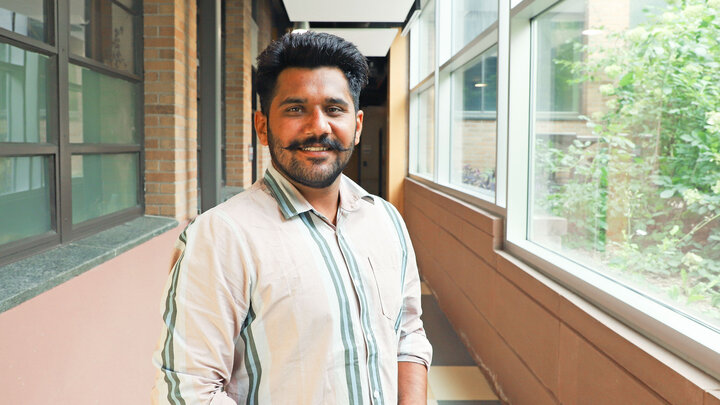
Akashdeep Kamboj spent the majority of his life in Punjab, India, but since he moved to Nebraska for his doctoral studies, he has developed a fondness for the state and the kindness of its people.
“Lincoln is the best place,” Kamboj said. “People are so polite. That's why I say there's no place like Nebraska.”
Living in a new country was a challenging transition, but Kamboj says that the trademark ‘Nebraska nice’ treatment from community members and the guidance and encouragement from his faculty mentors made him feel right at home.
“I'm really fortunate to be advised by Dr. Katherine Frels and Dr. Blaine Johnson,” Kamboj said. “They're superb. They both helped me learn to speak confidently and I would not be the same person I am here today without them, to be honest.”
Kamboj is a doctoral candidate in the University of Nebraska-Lincoln’s Department of Agronomy and Horticulture specializing in plant breeding and genetics. He earned his bachelor’s in agriculture from Punjabi University, Patiala, India in 2017 and his genetics and plant breeding master’s in 2019 from Lovely Professional University, Phagwara, India.
Kamboj started his doctoral studies in the spring of 2023 with the university’s small grains breeding program. This fall, he began his doctoral candidacy. He is currently leading a hybrid wheat breeding program focused on increasing yield potential.
“Hybrids for any crop are made because hybrids have a better potential to produce more yield,” Kamboj said. “If we're saying corn or canola, hybrids are producing more than their parents. But so far hybrid wheat has not been extensively exploited.”
Successful hybrid breeding requires cross pollination, which poses a problem in hybrid wheat production because wheat is a self-pollinating crop. Kamboj hopes to replicate the success of other hybrid crops by using a chemical hybridizing agent that forces wheat to cross-pollinate by removing its ability to self-pollinate.
“We want to make hybrids cost effective on a bigger scale using this chemical hybridizing agent,” Kamboj said.
He and his research team are testing wheat hybrids in Alliance, Lincoln and North Platte. Kamboj is also using drone phenotyping and genomics to predict hybrid wheat yield. Preliminary results are promising – the hybrids are becoming superior to their parents – but there is still a lot of work to do.
“On a research basis, it's good,” Kamboj said. “But on a bigger scale, there are still a lot of challenges we need to work through, specifically the cost effectiveness of hybrid production.”
By integrating large-scale field trials with phenomics, genomics and machine learning, Akashdeep’s research has demonstrated that hybrid wheat consistently outperforms top pure-line varieties, highlighting its potential to improve yield and stability across diverse environments.
Kamboj has earned national recognition for his research. In January, he had the opportunity to present at the WheatCAP International Plant and Animal Genome Conference in San Diego where he earned first place in the Lightning Talk. Then, in November, he presented research about hybrid wheat breeding at the Canvas 2025 conference in Salt Lake City.
“It went so great,” Kamboj said. “I did posters and other presentations. People were very interested in our hybrid wheat research, and the achievements that we are making.”
Just this year, he was also awarded the Milton E. Mohr Scholarship and Fellowship Award from the Nebraska Center for Biotechnology, the Henry M. Beachell Fellowship from the Department of Agronomy and Horticulture and second place in the department’s elevator speech contest.
He is also heavily involved in the department, the university and the community. He is the current treasurer for the Agronomy and Horticulture Graduate Student Association, a peer mentor for masters and doctoral students and has supervised five interns. He was an organizing committee member for the McFadden Symposium and Nebraska Plant Science Symposium, and a volunteer judge at the Nebraska Junior Academy of Science Regional Science Fair in 2025. Kamboj is even the vice president of the university’s cricket club.
In addition to playing cricket, Kamboj enjoys watching funny movies and cooking Punjabi food.
“Being a vegetarian, I cook vegetable dishes,” Kamboj said. “I make homemade cheese too, I don't get it from the market.”
Kamboj is uncertain about what the future holds, but when he finishes his doctoral candidacy he hopes to stay in the midwest and continue making a difference through his research.
“I wish to explore more advanced learning techniques as well and use my knowledge to give back to the community,” Kamboj said.