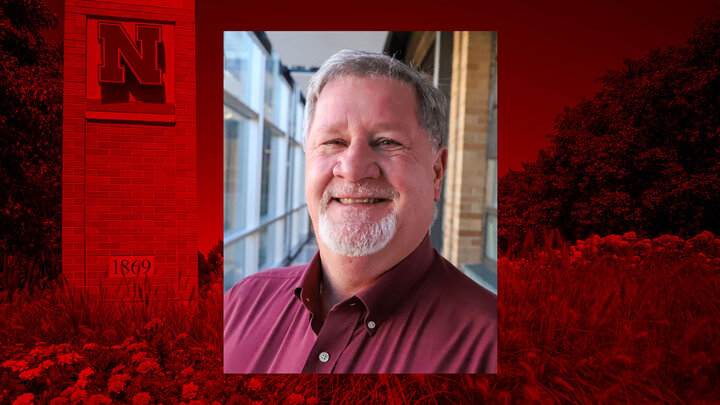
Daren Redfearn, range and forage sciences professor in the Department of Agronomy and Horticulture, retires June 30, 2026, after a 12-year career at the University of Nebraska-Lincoln.
Redfearn will be recognized alongside Jerry Volesky and Rhae Drijber at a joint retirement celebration from 2 to 4 p.m. on May 8 at the Goodding Learning Center in Plant Sciences Hall. Anyone who wants to share their thoughts, stories, best wishes and photos to celebrate his retirement can sign his online guestbook.
Redfearn is originally from Mount Pleasant, Texas, a town in the northeast corner of the state near Oklahoma, Arkansas and Louisiana. He lived there until he left for college in 1981. His grandfather was a sharecropper, so Redfearn developed an interest in agriculture, but his parents pushed him away from a career in ag. They lived in poverty their entire lives and didn’t want that for him, so he went to Texas Tech University as a pre-vet major.
“The way I found Texas Tech effectively was putting a string on a pin and putting that pin in Mount Pleasant and seeing how far I could get in Texas without leaving, and I found myself in Lubbock, about 450 miles away,” Redfearn said. “My pre-vet didn't last very long because I ran into a class named calculus that did not treat me very well. But I still stayed in animal science.”
He graduated with a bachelor’s in animal science in 1985 and returned to Mount Pleasant to work at a poultry processing plant.
“It took me six months to realize I'd made a bad decision and then about three more years to get something done about it,” Redfearn said.
He got into contact with one of the faculty members at a local community college that his mother knew, who connected him with Terry Klopfenstein in the Department of Animal Science at Nebraska. Redfearn began his master’s program in July 1989 at the university in the Department of Agronomy with an emphasis in range and forage science.
There weren’t any openings in the animal science department, but Steve Waller and Lowell Moser in the Department of Agronomy were looking for graduate students. They were initially skeptical about his background in animal science, but they accepted him into the program and became his advisers.
“The first day I was here, Steve walked in the office and he handed me a plant physiology book and said, ‘here, you need to learn this, and when you do, come back and talk to me,’ so that was kind of an eye-opener,” Redfearn said.
His master’s research project was one of the first multidisciplinary studies across departments at the university; a study of non-degradable rumen protein in forages that included components stretching across agronomy, animal science and agricultural economics. Redfearn graduated with his master’s degree in 1991 and stayed at Nebraska for his doctoral program, in which he studied the growth and development of switchgrass until he graduated in 1995.
He did a postdoctoral program with the U.S. Department of Agriculture’s Agricultural Research Service at Iowa State University for nearly two years researching the quality of corn silage before moving into a research position as a forage agronomist at a Louisiana State University research station. In this position he had a wealth of resources; access to equipment, fields and a large crew of technicians and field staff. His job required him to know a little bit about genetics, individual species breeding, fertilization, weed control, agronomic management and about the internal processes of animals that consumed forage.
Redfearn left Louisiana State University in 2000 and took on an extension and teaching appointment at Oklahoma State University – transitioning from a 100% research appointment to a 60% extension and 40% teaching appointment. He worked there for about 15 years, in which he taught forage and pasture management, cropland ecosystems, crop physiology, a freshman orientation course and a graduate seminar and served as the agronomy club adviser.
Redfearn began working at Nebraska on June 14, 2014, in a 60% extension and 40% research position. It was a fantastic opportunity, one Redfearn says was so perfect for him, he couldn’t have written it better himself. He was hired as part of a strategic team to address relevant issues in forage-based beef production systems.
“They called it a cluster hire,” he said. “I was hired as the forage agronomist, Mary Drewnoski was hired as the ruminant nutritionist, the animal scientist and then Jay Parsons was hired as the ag econ and farm management person. And we all started within a month of each other.”
A key part of the research team’s project was implementing participatory research into their strategy by conducting farmer and rancher focus groups.
“Participatory research is more impactful and can speed development and adoption of new production systems,” Redfearn said.
Parsons has continued to work closely with Redfearn over the last several years. When asked about Redfearn's impact on the university and extension, Parsons praised his contributions to their joint projects and the university's agricultural work.
“It has been an absolute honor to work with Dr. Redfearn for the last 12 years," Parsons said. "His practical insight and knowledgeable approach to addressing real world problems in modern agriculture have been a tremendous asset to this university. He is a credit to the land-grant system. His contributions have been tremendous, and I wish him well in his retirement.”
In 2021, he transitioned into a 25% extension, 25% research and 50% Institute of Agriculture and Natural Resources administrative service role.
Redfearn particularly enjoys interdisciplinary research and extension projects that answer larger questions.
“I have led or participated in several large grants that have addressed questions about soil health and using cover crops as a forage resource,” he said.
One of these projects led by Redfearn assessed the value of grazed corn residue for corn growers and livestock producers in Nebraska, Kansas, South Dakota and North Dakota.
“We identified opportunities to expand corn residue use through grazing and provided an economic assessment for value-added grazing,” Redfearn said. “We used field-scale production data to construct enterprise budgets that evaluated system profitability on marginally productive cropland. We found crop-forage-livestock systems were not consistently more profitable than continuous corn production; however, baling hay only (no grazing) was more profitable than continuous corn production.”
His team also made key findings related to greenhouse gas emissions, suggesting that grazing perennial pastures did not consistently impact soil greenhouse gas emissions, crop residue and cover crop management may impact soil nitrous oxide emissions and that continuous corn production has greater soil nitrous oxide emissions than perennial grass pastures because of higher application amounts of synthetic nitrogen fertilizer.
Redfearn never had a formal teaching appointment at Nebraska, but he advised or co-advised 10 graduate students and served on 16 master's and doctoral committees.
While at UNL, Redfearn published his research in 26 journal articles, six book chapters and approximately 200 other publications consisting of research abstracts, peer reviewed extension publications, conference proceedings, research reports, popular press and software products.
He has been recognized individually for his research, extension and service contributions in 2024 as an American Society of Agronomy Fellow and as a Crop Science Society of America Fellow. His research teams have been recognized for several accolades as well. Redfearn earned the National Excellence in Multistate Research award from the agInnovation North Central Multistate Research Committee in 2026 for optimizing land use for beef cattle. He also earned the Extension Education Community Materials Awards Program Certificate of Excellence from the American Society of Agronomy twice, once in 2017 for a Range, Pasture and Forages website and again in 2019 for the Hail Know website.
“It's good to be recognized for that, but at the end of the day, I've just tried to do what I thought was the right thing to be doing,” Redfearn said.
In his retirement, Redfearn plans to catch up on travel plans.


